
Eviction Notice in Dubai: Complete Guide for Landlords 2026
Eviction notice in Dubai is not just a “notice to vacate” email. In Dubai, eviction is a regulated legal process governed by the tenancy laws and enforced through the Rental Disputes Center (RDC).
If the notice is drafted incorrectly, served using the wrong method, or based on a reason that is not allowed, it can be rejected, and you may lose months.
This guide gives landlords a practical, legally grounded walkthrough of eviction in Dubai. It follows Dubai tenancy rules and the common procedural requirements landlords must meet. In specific cases, notices must be notarized by a notary and served via mail, as required by Dubai Land Department guidelines.
Key Takeaways
- An eviction notice in Dubai must meet legal requirements for reason, timing, and service method to be enforceable.
- Evictions fall into two buckets: tenant breach during the lease, or landlord grounds at contract expiry under limited legal reasons.
- Validity depends on three things: a legally permitted reason, the correct notice period, and the correct service method.
- Know your eviction type: tenant breach during the lease vs landlord led eviction at contract expiry under limited legal grounds.
- Serve it the right way with proof: relying only on email or WhatsApp can weaken or invalidate the notice; formal service and delivery evidence matters.
Table of Contents
What Is an Eviction Notice in Dubai?
An eviction notice in Dubai is a formal written notice from a landlord to a tenant requesting the tenant to vacate a rented property, either:
- During the tenancy term, the tenancy contract was breached because the tenant breached the law or the tenancy contract (for example, non-payment of rent after proper notice).
- At the end of the tenancy contract for limited reasons allowed by law (for example, sale, personal use, or major works in the property), provided the landlord gives a compliant advance notice.
It is often called a “legal notice,” and it must meet strict requirements around reason, timing, and service method to be enforceable.
Dubai Rental Law Basics (RERA/RDC): What Landlords Must Know
Dubai’s rental market is regulated through a framework that includes:
Ejari registration is the baseline
Ejari is the official tenancy registration system connected to RERA. Most landlord-tenant actions, including disputes, rely on the existence of a valid Ejari and tenancy contract.
RERA sets the regulatory environment
RERA is the regulator of the real estate sector and establishes systems like Ejari and market guidance.
RDC is where eviction disputes are enforced
If a tenant does not comply with a valid notice, landlords typically pursue the matter through the Rental Disputes Center.
RDC procedures commonly rely on proof that the tenant was formally notified through a legal/eviction notice notarized by a notary and served via registered mail for certain legal steps.
Practical takeaway: A RERA eviction notice in Dubai process is not about sending messages; it is about creating evidence that will stand up if the matter reaches the RDC.
Valid Reasons for Eviction in Dubai
Dubai tenancy law distinguishes between eviction before contract expiry (usually breach-based) and eviction upon contract expiry (limited landlord reasons). Article 25 lists the permitted grounds.
1) Eviction before the contract ends (tenant breach)
A landlord may seek eviction before expiry only in specific cases, including:
- Non-payment of rent within 30 days after the landlord serves a notice to pay
- Subletting without written landlord approval.
- Illegal use or conduct that breaches public order or morals.
- Commercial property left unoccupied for set periods without a valid reason.
- Willful damage or changes that make the property unsafe.
- Using the property for a purpose other than the leased purpose or in violation of planning and use regulations.
- Failure to observe legal or contractual obligations within 30 days of a notice to perform.
- Eviction required due to government-mandated demolition or redevelopment.
Important: for breach cases, landlords generally must first notify the tenant to pay or remedy the breach within the legally required timeframe, then escalate if the tenant fails to comply.
2) Eviction at contract expiry (landlord reasons with strict limits)
Upon expiry of the tenancy contract, the landlord may request eviction only if:
- The landlord wants to demolish and reconstruct or add works, preventing the tenant from benefiting from the unit, without the required permits.
- The property needs comprehensive maintenance or restoration that cannot be done while occupied, supported by a municipality-attested technical report.
- The landlord wants the property for personal use or use by first-degree relatives and must show no suitable alternative property for that purpose.
- The landlord wants to sell the property.
These are the most common grounds used by landlords when issuing an eviction notice in Dubai that is not tied to tenant wrongdoing.
Notice Periods Explained
Notice periods depend on the eviction basis:
Breach-based cases can be much faster, but still require notice steps
For rent non-payment cases, the 30-day notice and next legal steps are explained in detail in our tenant eviction due to non-payment of rent in Dubai guide.
For other contractual or legal breaches, the law also references a 30-day window after notice to perform the obligation.
No fault eviction at contract expiry requires 12 month notice
If the landlord is seeking eviction at the end of the lease for the limited reasons above (sale, personal use, major works), the landlord must notify the tenant 12 months before the eviction date, and that notice must be notarized by a notary and served via registered mail.
🔗If you need to evict a tenant before the contract ends, read our guide on how a landlord in Dubai can evict a tenant for the legal steps and notice rules.
The service method is part of the notice requirement
Dubai tenancy law explicitly ties valid notice service to a notary public or registered mail in key eviction contexts.
This is why many landlords lose time: even if the tenant “knows,” a non-compliant service method can collapse the case later.
Step by Step: How to Send an Eviction Notice in Dubai
Below is a practical process that aligns with common legal requirements and what landlords typically need for enforceability.
Steps |
Purpose |
What to do |
Step 1 |
Confirm reason and timeline | Identify whether it’s breach or contract expiry eviction, then apply the correct notice period: 30 days to remedy or 12 months for sale, personal use, or major works. |
Step 2 |
Draft the eviction notice | Add Ejari matching names, property details, legal reason, eviction date, notice period, and any payment or compliance deadline for breach cases. |
Step 3 |
Notarize the notice | Notarize through Dubai Courts Notary or Ministry of Justice Notary (for non-UAE resident landlords), where required to support legal validity and dispute acceptance. |
Step 4 |
Serve it the right way | Serve via the approved method, such as registered mail, and keep the courier delivery proof. |
Step 5 |
Keep proof and documents | Keep the notarized notice, delivery proof, and core documents, such as Ejari, tenancy contract, and title deed, for RDC filing. |
🔗 For a detailed walkthrough of the full process, read our guide on how to file an eviction notice to a tenant in Dubai.
Documents Required
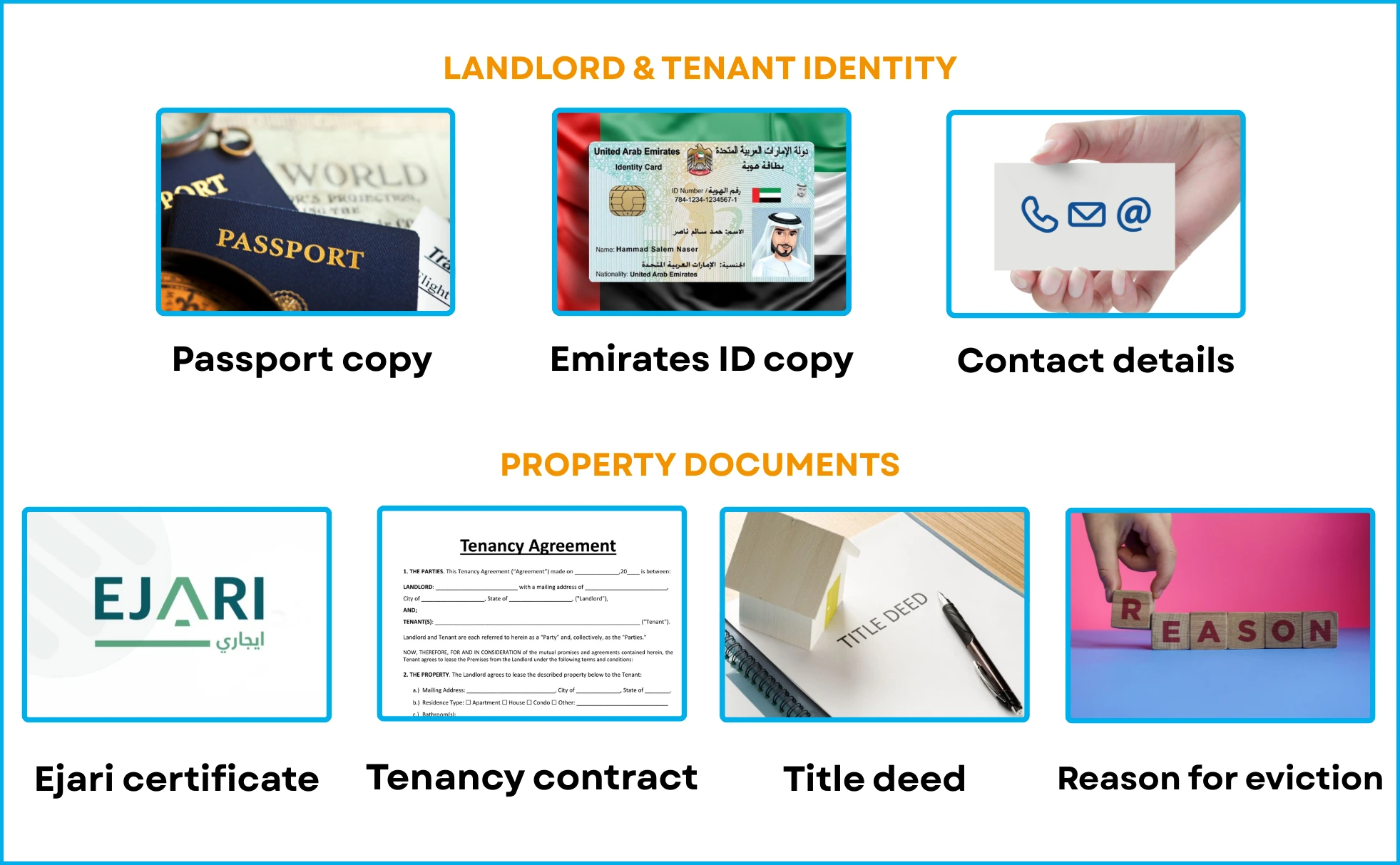
While exact documentation can vary by case type, a complete landlord file typically includes the following items (commonly requested for preparing and serving a compliant notice):
- Passport copy of the landlord
- Emirates ID copy of the landlord
- Contact information of the landlord (mobile and email address)
- A passport copy of the tenant
- Emirates ID copy of the tenant
- Contact information of the tenant (mobile and email address)
- Ejari certificate
- Tenancy contract
- Title deed
- Clear stated reason for eviction
For certain grounds, you may also need supporting evidence, such as permits for demolition, or a technical report for major maintenance where required by law.
Common Mistakes That Make an Eviction Notice Invalid
-
Using the wrong reason
Eviction grounds are limited. If your reason does not match Article 25, the notice may fail.
-
Wrong notice period
Many landlords assume “end of contract” means immediate. For sale, personal use, or major works, the notice must be 12 months before the eviction date.
-
Serving by email or WhatsApp only
Informal messages can support communication, but key eviction notices must be served through the correct formal channel in relevant cases.
-
No proof of delivery
If you cannot prove service, you risk losing at RDC even if your reason is valid.
-
Incorrect names or property details
If the tenant’s name does not match the Ejari or contract records, or the unit details are incorrect, tenants can challenge the notice.
-
Not addressing breach cure requirements
For breach cases, you generally must first notify and allow the legally required window to remedy before pushing eviction.
-
Contradicting your own stated reason later
Claiming personal use and then re-leasing can expose you to compensation risk.
Eviction Notice to Tenant Service: How We Help
Drafting that matches Dubai tenancy law
POA.ae prepares eviction notices in the correct structure, with the reason aligned to the legally permitted grounds, so it stands up if challenged.
Notarization support
We coordinate with the Dubai Courts Notary and Ministry of Justice Notary for notarization as part of our standard workflow, ensuring the notice is officially formalized for legal use.
Serving the notice with proof
We serve the eviction notice through a registered postal courier, ensuring delivery evidence, which is essential if the tenant disputes receipt.
End-to-end guidance if the tenant does not vacate
If a tenant refuses to leave after valid service, we guide you on the next steps and what documentation is typically needed for escalation through the proper dispute channels.
If your goal is to avoid delays and ensure your eviction notice pathway is not blocked by technical errors, the safest approach is to have the notice drafted, notarized, and served professionally through POA.ae’s eviction notice to tenants service.
FAQs
1) Can a landlord evict a tenant in Dubai by email?
An email alone is not sufficient. The proper service method requires legal acceptance, such as notarizing the notice by a notary and serving it via registered mail.
2) How much notice is required for an eviction notice in Dubai if I want to sell my property?
For eviction upon contract expiry due to sale, the landlord must notify the tenant at least 12 months before the eviction date. The notice must be notarized by a notary and served via registered mail.
3) What is the RERA eviction notice Dubai rule for personal use?
Personal use eviction is permitted only under limited circumstances and requires 12 months’ written notice. The notice must be notarized by a notary and served via registered mail.
4) Can I evict a tenant for non-payment of rent?
The law allows eviction for non-payment if the tenant fails to pay within 30 days after being served a notice to pay (unless agreed otherwise), after which you may escalate through the legal route.
5) What documents do I need for an eviction notice in Dubai?
Common requirements include Ejari, tenancy contract, title deed, landlord and tenant IDs, and the reason for eviction, along with delivery proof once served.
Conclusion
An eviction notice in Dubai only works when it is legally valid, correctly timed, and properly served with proof.
Whether you are dealing with a tenant breach or planning an eviction at contract expiry for sale, personal use, or major works, the smallest mistake in wording, dates, or service method can delay your case and weaken your position at RDC.
If you want to avoid rejection risks and protect your timeline,
POA.ae can manage the entire eviction notice process for you, including drafting the notice, online notarization through various notaries in Dubai, and formal service to the tenant with proof of delivery.
Disclaimer: poa.ae is a registered trademark and an online portal. It is NOT a notary office or a law firm. Any reference to potential legal services or notary services is outsourced to lawyers, law firms, or notaries licensed to practice in an appropriate jurisdiction. Your access to the website and use of our services is subject to our Terms and Conditions, Cookie Policy, nd Privacy Policy.
About the author

Recent Posts

January 20, 2026

January 13, 2026


November 26, 2025

November 23, 2025